The Invisible Drain on Enterprise Productivity
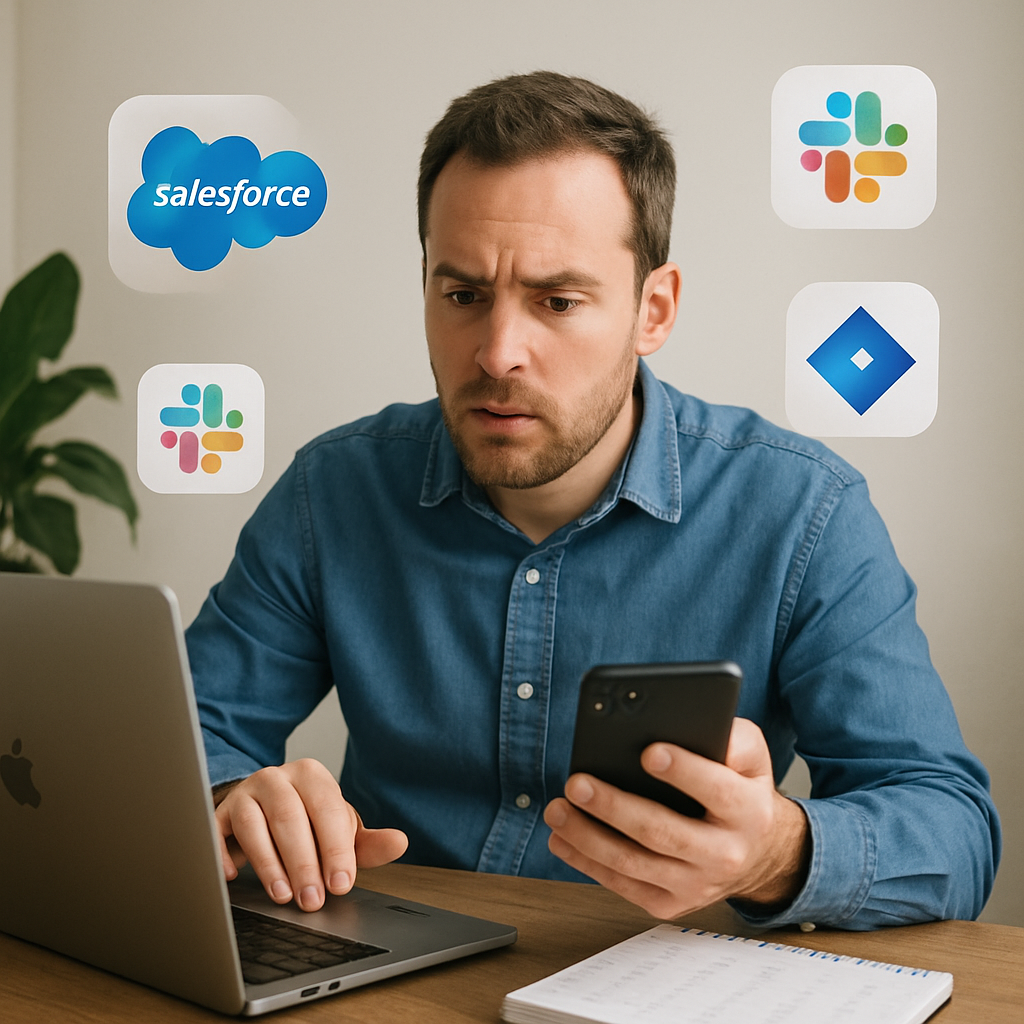
As businesses continue to adopt diverse digital tools to empower operations and collaboration, a new silent productivity killer has emerged—the Toggle Tax. This phenomenon isn’t just about mere annoyance or frustration; it’s a quantifiable operational inefficiency costing enterprises up to $32,000 annually per employee.
When employees continuously toggle between apps like Slack, Salesforce, Greenhouse, and Jira, they encounter ‘Digital Friction.’ The resulting loss of focus, compounded by manual processes and fragmented systems, leads to reduced overall productivity at scale within the enterprise environment.
App-Switching Costs: More Than Lost Time
A Harvard Business Review study revealed that employees switch between applications more than 1,200 times a day. Each switch creates micro-delays in cognitive recovery, task resumption, and decision-making. Calculating this inefficiency across an entire enterprise workforce unveils a staggering $32k annual productivity loss per employee. The results? Slower project cycles, delayed reporting, and poorly optimized governance frameworks.
Introducing Agentic AI: Fixing Fragmentation
Traditional workplace tools like chatbots or GenAI text helpers focus on isolated moments of productivity—answering a question quickly or summarizing a document. While these tools may be helpful, they rarely eliminate the root causes of digital friction. This is where Agentic AI shines.
More than mere automation, Agentic AI serves as an orchestration hub, intelligently connecting tools and streamlining tasks end-to-end across platforms like SAP, Excel, and Slack. For example, imagine reducing your financial reporting workload to zero by automating task execution rather than task setup. Agentic AI transforms disconnected tools into a governed action layer, solving inefficiencies holistically and enabling autonomous systems that scale.
The Human Middleware Problem
Many enterprises today rely on ‘Human Middleware’—dedicated employees or entire teams who manually bridge gaps between disconnected systems. For instance, your operations team might manually aggregate data from Trello, update records in Salesforce, and then email stakeholders for feedback. These repetitive manual workflows form the costly fabric of the Toggle Tax.
Agentic AI eliminates the need for this redundant layer by governing action across platforms. This reduces reliance on human intervention for basic workflows while promoting real-time decision-making without sacrificing accountability or oversight.
How Orchestration Hubs Solve Digital Friction
- Smarter Connectivity: Agentic AI integrates seamlessly with your existing stack, uniting disparate tools like Jira, Greenhouse, and Slack to flow data efficiently across systems.
- Enhanced Employee Productivity: Delegates app-switching and data collation tasks to autonomous systems, so your staff can focus on strategic decision-making.
- Governed Action: Ensure workflows and compliance rules are consistently followed without interrupting speed or autonomy.
- Measurable ROI: Speed up project execution cycles, reduce operational risk, and save thousands annually per employee within your ecosystem.
Conclusion: Move Beyond Tools to Solutions
The Toggle Tax reminds us of the hidden cost lingering in enterprises reliant on fragmented systems. While digital friction may seem inevitable in today’s SaaS-driven workplaces, adopting governed Agentic AI infrastructure ensures your systems work cohesively, eliminating inefficiencies tied to app-switching.
More than a productivity tool, orchestration hubs powered by Agentic AI position enterprises to scale effectively. By moving beyond ‘human middleware’ and simplistic automation, leaders like COOs and CIOs can achieve streamlined, governed workflows that maximize ROI and empower decision velocity.
Are you ready to tackle the Toggle Tax head-on?
Leave a Reply