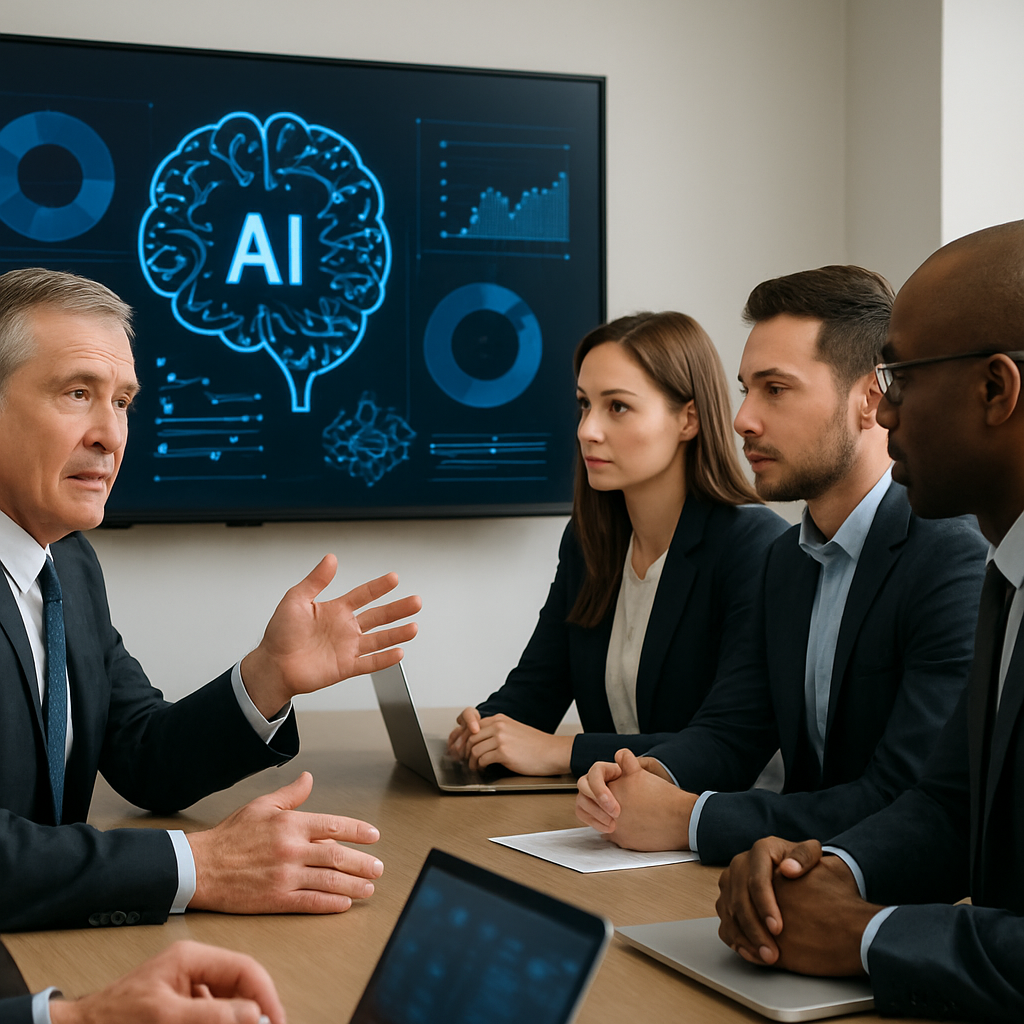
Understanding the Divide: Generative AI vs Agentic AI
Generative AI, often highlighted for its content creation capabilities, excels in producing text, images, or other outputs based on input prompts. Its primary use has been in areas like marketing, customer support, and creative industries.
In contrast, agentic AI redefines automation by enabling governed, autonomous actions specifically designed for operational tasks in enterprises. Unlike generative AI, agentic AI doesn’t stop at creating content; it identifies, orchestrates, and executes workflows with precision.
- Generative AI: Focus on content generation.
- Agentic AI: Emphasis on executing policies and automating workflows.
- Agentic AI ensures compliance and governance while reducing human intervention.
The Case for Agentic AI in Enterprises
Agentic AI brings operational balance by integrating autonomous decision-making and governed actions into enterprise systems. This model minimizes inefficiencies like redundant tasks, misalignment, and compliance risks that often bog down traditional automation tools.
Hypothetically, consider a multinational manufacturing company implementing agentic AI to automate supply chain operations. By aligning ERP systems with autonomous task execution, the company reduced manual interventions by 70%, saving millions of dollars annually while maintaining compliance across regions.
Common Shortcomings of Generative AI
Generative AI tools often lack real-time contextual understanding and decision-making capabilities crucial for operations. While they excel at output generation, they frequently require substantial human effort to translate outputs into executable actions.
Performance gaps also emerge when generative AI tools are used in environments that demand precise coordination between multiple systems—such as order management or engineering processes. These limitations make generative AI unreliable for mission-critical enterprise workflows.
Governance in Agentic AI: A Non-Negotiable Requirement
Governance underpins the efficiency and reliability of agentic AI systems. Every action executed by an AI agent should comply with enterprise-wide policies, ethical standards, and security protocols.
The introduction of governance layers ensures that agentic AI actions are auditable, maintaining transparency and building trust among stakeholders.
- Governance ensures data protection and accountability.
- Auditable agent actions build compliance and reduce legal risks.
- Consistent monitoring mitigates errors in automated workflows.
Step-by-Step Guide: Integrating Agentic AI in Your Enterprise
Transitioning to agentic AI requires a structured approach. Here's how enterprises can implement these systems for maximum return on investment:
- Assess existing workflows: Identify repeatable processes suited for automation.
- Choose a reliable orchestration hub integrated with agentic AI capabilities.
- Develop governance policies to oversee AI actions and ensure compliance.
- Monitor and iterate channels for scaling operations autonomously.
Why Agentic AI is the Future of Automation
Agentic AI represents the next evolutionary step in enterprise automation, where operational efficiency meets governance. Its ability to handle complex, rule-bound workflows and adapt in real-time makes it an indispensable tool for COOs, CIOs, and Heads of Operations.
As enterprises navigate challenges like scaling operations, managing compliance, and reducing human middleware, agentic AI’s role in driving transformation cannot be overstated.
- https://www.forbes.com/sites/maribellopez/2025/12/10/aws-reinvent-how-ai-agents-makes-enterprise-automation-scalable/
- https://www.microsoft.com/en-us/microsoft-cloud-blog/multi-agentic-ai-unlocking-business-transformation
- https://www.msn.com/en-us/technology/artificial-intelligence/leading-the-agentic-enterprise-what-the-next-wave-of-ai-demands-from-ceos/ar-AA1SdCe3
Leave a Reply