Introduction
For many enterprises, the promise of artificial intelligence stops at thought – generating content, processing data, or summarizing information. While generative AI tools, like chatbots, have brought significant value in terms of insights, their inability to drive governed, autonomous action leaves a glaring gap for enterprise leaders. Businesses today need more than answers; they need systems that act, integrate, and scale. Enter Agentic AI—the next evolution in enterprise technology.
Why Generative AI Falls Short for Enterprises
Generative AI tools can process vast amounts of data and produce useful outputs, such as textual responses or summaries. Yet, there’s a limitation that many CIOs and COOs recognize. These tools are static in their ability to inform but fail to integrate deeply into enterprise workflows to execute. Beyond producing outputs, enterprises need solutions that can:
- Eliminate operational silos by directly interacting with existing systems like Jira, Salesforce, and Slack.
- Ensure actions are governed within enterprise protocols, reducing operational risks.
- Scale not only in usage but in end-to-end impact across departments.
Generative AI can answer questions about a problem; agentic AI steps in to solve it, autonomously.
What is Agentic AI, and How Does It Transform Businesses?
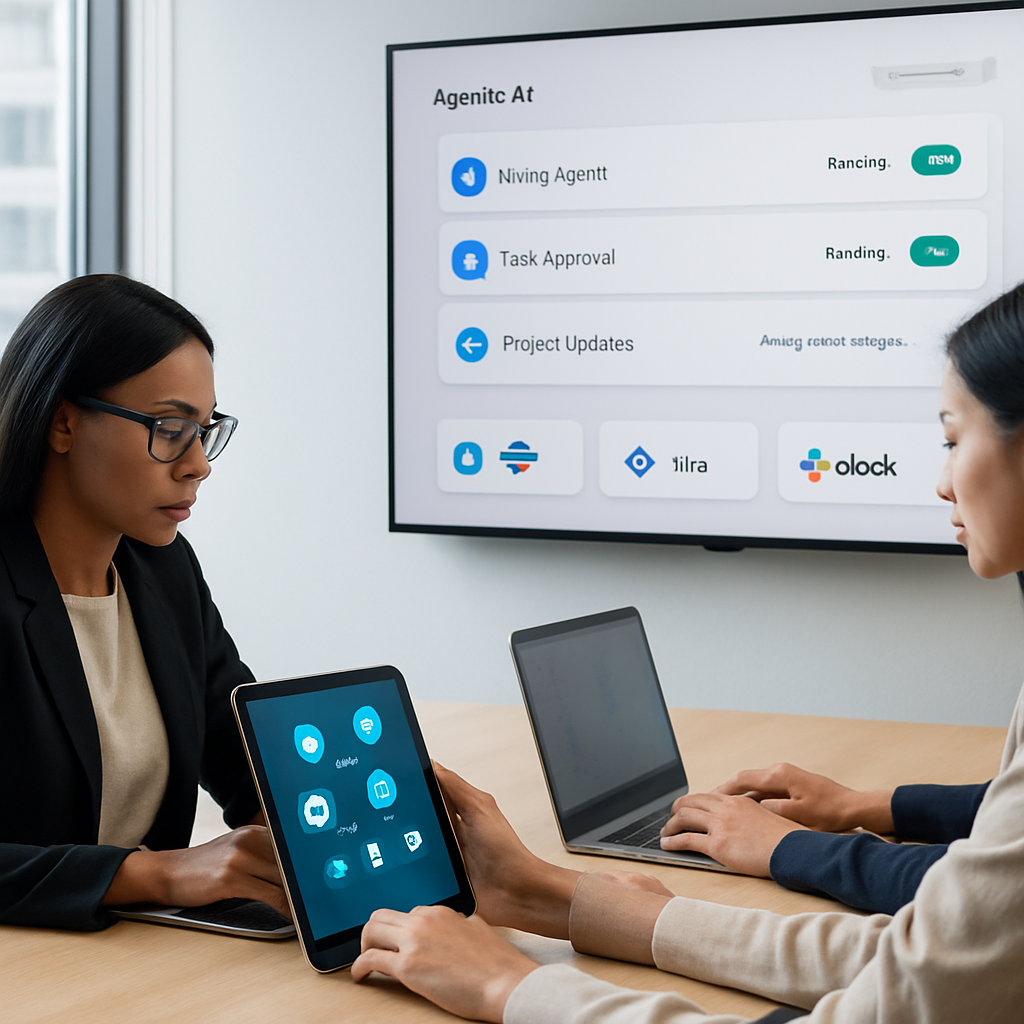
Agentic AI represents a paradigm shift in how enterprises operate at scale. Unlike tools that passively generate content, agentic AI functions as an enterprise action engine. It performs:
- Autonomous Execution: Connects with enterprise systems to execute governed, end-to-end workflows. For instance, it can take a hiring decision from approval in Greenhouse to generating an offer on workplace systems autonomously.
- Seamless Integration: Operates as an orchestration hub that bridges fragmented systems. It not only understands Jira or Salesforce but builds consistent actions between them.
- Governed Actions: Ensures all actions follow enterprise compliance protocols, eliminating potential risks or errors common with fragmented execution.
This ability to act—not just think—unlocks substantial time and cost savings. Instead of relying on manual coordination or ‘human middleware,’ your enterprise runs like a self-governing machine.
Use Cases: From Impossible Workloads to Effortless Workflow
Let’s break down why Agentic AI is the future of enterprise operations with some real-world examples:
- Recruitment Efficiency: Sourcing, evaluating, hiring, and onboarding candidates usually requires input from multiple platforms and teams. Agentic AI integrates Greenhouse, Slack, and your payroll system, eliminating redundant tasks and delivering a competitive time-to-hire edge.
- Salesforce Automation: Instead of manually toggling reports or migrating lead status reports, agentic AI unites tools like Salesforce, Slack, and email to auto-trigger sales actions in real-time. The result is a shorter deal cycle and fewer errors.
- Engineering Workflow Orchestration: Tools like Jira, GitHub, and Slack are essential but notorious for silos. Agentic AI unifies these tools so engineering teams can focus on building—not backtracking or toggling. For example, it can automatically update Slack channels with issue resolutions as they happen in Jira.
Conclusion: Moving Enterprises from Insights to Action
As enterprises face mounting pressure to operate efficiently in an increasingly connected world, the limitations of generative AI are clear—it solves for thinking, not for doing. By adopting Agentic AI as part of their operational infrastructure, enterprises can bridge app gaps, eliminate toggle tax, and build workflows that scale with governed metrics. Moodbit’s robust orchestration hub brings this vision to life, helping CIOs and COOs deliver tangible ROI while evolving their infrastructure for a future defined by action and automation.
For businesses ready to shift from static AI outputs to complete Agentic AI-driven systems, the time to act is now.
Leave a Reply